
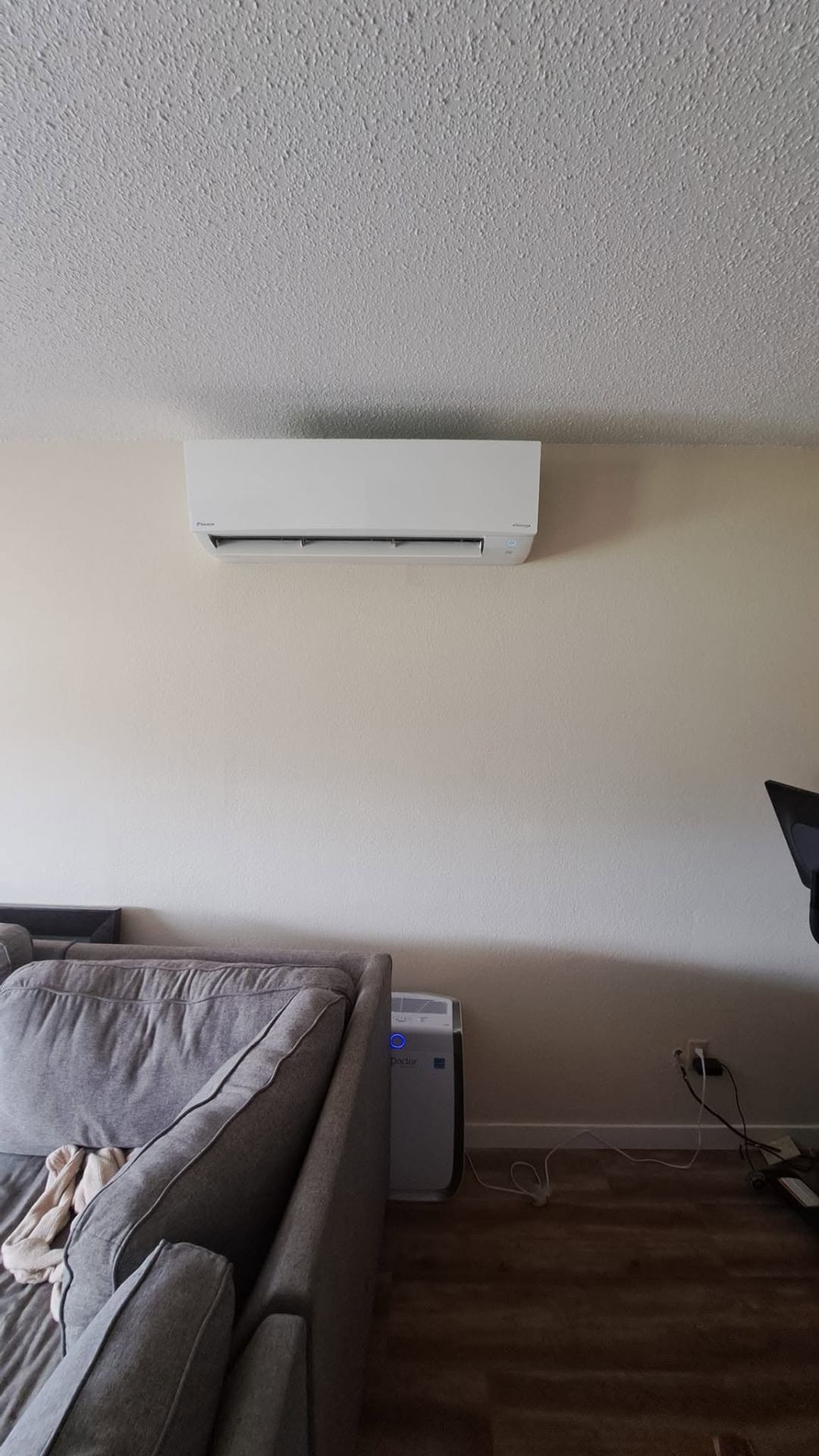
Ductless mini-splits solve a problem that used to have no good answer: how do you heat and cool a space that has no ductwork and never will? A 1940s Wenatchee bungalow with baseboards. A finished garage shop. A bedroom over the garage that has been either freezing or baking since the day it was built. A Leavenworth cabin. These are the calls where a mini-split is not a compromise, it is the right tool.
How a ductless system works
A mini-split is a heat pump with the ducts removed from the equation. An outdoor compressor unit connects to one or more indoor heads through a small line set carrying refrigerant, a condensate drain, and control wiring, through a hole roughly three inches across. Each indoor head conditions the space it is mounted in, delivering heating in winter and cooling in summer.
Because no air travels through duct runs, you lose none of your conditioned air to leaky ducts in an unconditioned attic or crawlspace. In older homes that alone can be a significant share of what a ducted system was wasting.
Where they shine
Older homes with no ducts
Retrofitting ductwork into a house that was never designed for it means soffits, lost closet space, and a construction project. Mini-splits skip all of it, and homes currently on baseboards or wall heaters usually see the biggest comfort and operating improvement of anyone we install for.
Bedrooms and problem rooms
The room at the end of the duct run, the addition, the converted attic, the bonus room over the garage. If one or two rooms are the entire problem, conditioning the whole house harder is the wrong fix. A dedicated head is the right one, and mini-splits run very quietly, which matters in a bedroom.
Shops, garages, and outbuildings
A single head keeps a shop workable in January and in August, without extending the house system into a space with entirely different insulation and usage. Popular in this valley for woodshops, home gyms, and detached offices.
Cabins and vacation rentals
Cold-climate inverter models hold heating capacity into single-digit and negative temperatures, which is why we install them for mountain properties around Leavenworth, Plain, and Stevens Pass. Remote control and low standby draw suit properties that sit empty between stays.
Additions and remodels
Adding square footage often pushes an existing furnace or air conditioner past what it was sized for. A mini-split conditions the new space independently instead of forcing a whole-system replacement.
How zoning actually works
This is the part people underestimate. A conventional system has one thermostat deciding the temperature for the entire house, which is why the upstairs and the north bedroom never agree. With a multi-zone mini-split, each indoor head has its own setpoint and its own remote.
- Single zone: one outdoor unit, one indoor head. Best for a shop, an addition, or one problem room.
- Multi zone: one outdoor unit supporting several indoor heads, commonly two to five. Each zone sets its own temperature.
- Mixed head types: wall-mounted, ceiling cassette, floor-mounted, and slim ducted heads that hide in a soffit or closet and feed one or two registers where a visible head is unwelcome.
Practically, zoning means the bedroom can run at 66 while the living room holds 71, and you can shut the guest room down entirely when nobody is in it. Inverter compressors modulate to match the actual demand of whichever zones are calling, instead of running full blast and shutting off.
See our ductless mini-split installation and service
What installation involves
- 01
Load calculation and head placement
We measure each space rather than guessing, because an oversized mini-split short cycles, fails to remove humidity, and wears out early. Then we work out where the heads go for good air distribution and a clean look.
- 02
Mounting and line routing
The outdoor unit goes on a pad or wall bracket, sited for airflow, service access, drainage, and snow. Line sets route through a small penetration, sealed and flashed properly, run inside walls or in a neat exterior line cover.
- 03
Electrical and commissioning
A dedicated circuit and disconnect, permitted and code compliant. Then a proper vacuum on the line set, verified charge, and testing in both heating and cooling before we leave.
- 04
Cleanup and walkthrough
We show you the remotes, the filter access, and the settings that matter, and we leave the site clean. Most single-zone jobs are a one-day install, and multi-zone systems typically run one to three days.
Two details separate a mini-split that lasts from one that disappoints: a correct vacuum and charge, and correct head sizing. Both are invisible after the fact, which is exactly why they get skipped by people in a hurry.
Caring for a ductless system
- Rinse or vacuum the indoor head's washable filters monthly during heavy use. These filters are right behind the front panel and take two minutes.
- Wipe the head's intake and louvers and keep furniture and curtains out of the airflow path.
- Keep the outdoor unit clear of leaves, weeds, cottonwood fluff, and snow, and keep the condensate drain line running free.
- Have it professionally serviced annually, including a blower wheel and coil inspection, charge verification, and electrical testing. Indoor heads accumulate film on the blower wheel over years, and cleaning it restores airflow that homeowners rarely notice slipping away.
Homes converting from electric baseboards or wall heaters to a ductless system are also the homes utility conversion programs are aimed at, and eligibility depends on your utility and your current heating type.
Check current rebate details for ductless conversions
If you have a room that has never been comfortable, or a house on baseboards you are tired of paying for, call (509) 888-3389 or request a free estimate. We will tell you what your space actually needs, in writing, before any work begins.